Securing Server-Sent Events with OAuth2 Authentication
An examination of securing server-sent events using OAuth2 authentication to ensure real-time data integrity.
Securing Server-Sent Events with OAuth2 Authentication
Server-Sent Events (SSE) allow a server to push updates to a browser over a single, persistent HTTP connection. While this mechanism is efficient for real-time notifications, it introduces a specific security vulnerability: the connection remains open for minutes or hours, yet the initial handshake is just a standard HTTP request. Unlike WebSockets, which have a distinct upgrade protocol, SSE relies on the browser simply reading a stream of text. If the server does not enforce strict authentication at the moment the connection is established, an attacker can simply open a tab, fetch the stream, and harvest sensitive data indefinitely. The core mechanism for securing this is not to "lock" the stream after it starts, but to validate the OAuth2 access token before the server commits to sending any data.
This article is Part 1 of the "Spring Security & Real-Time Data Series".
The Mechanism of State and Connection Handshakes
The fundamental difference between a secure SSE implementation and an insecure one lies in the timing of the authentication check. In a standard REST API, you might validate a token on every POST or GET request. In SSE, the client makes one GET request and expects the server to keep the TCP connection open. If the server accepts the connection without verifying the identity of the requester, the stream is public. The solution is to treat the SSE endpoint exactly like any other protected resource: the server must reject the connection attempt if the Authorization header does not contain a valid, non-expired OAuth2 access token.
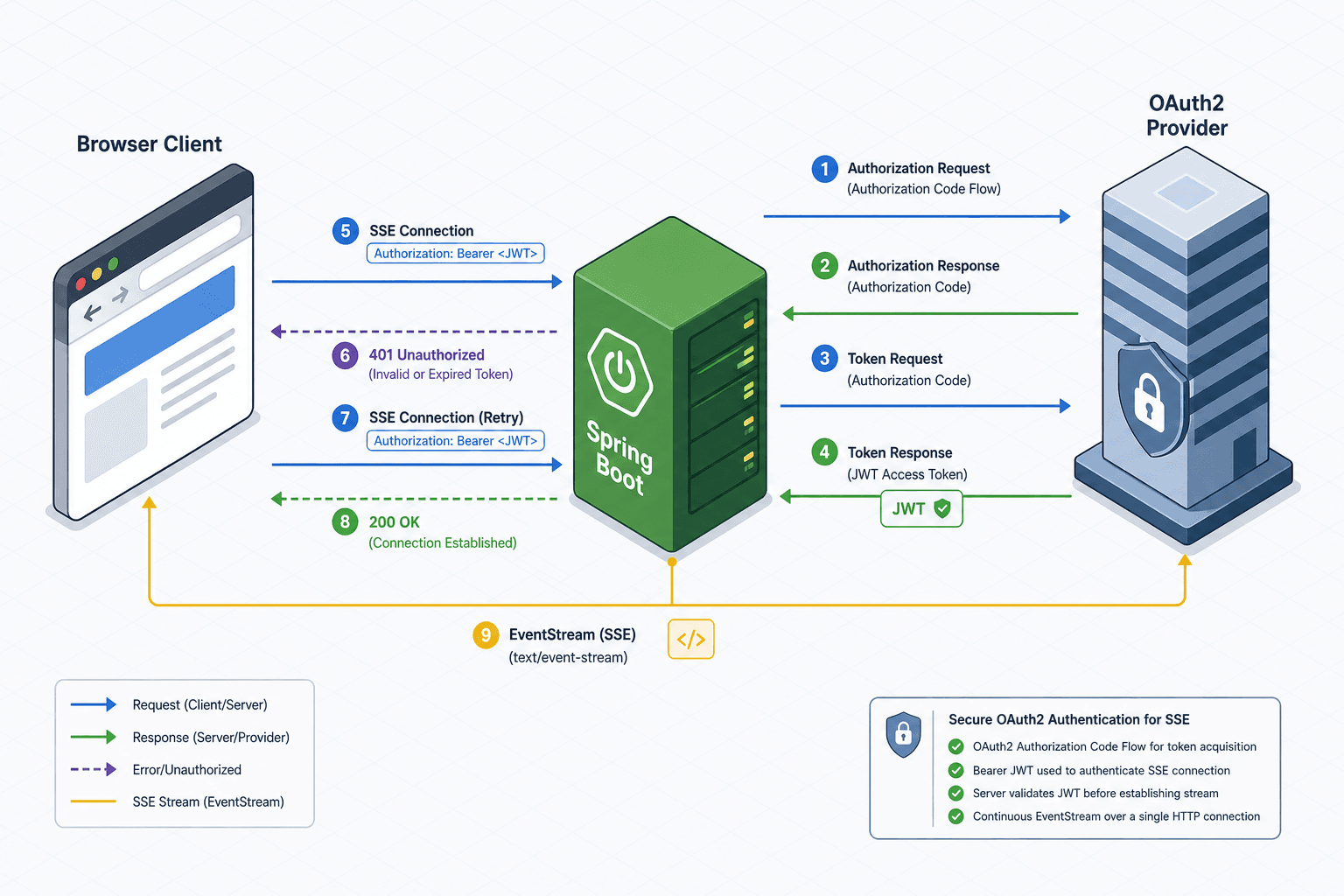
Consider a scenario involving a banking dashboard application. The frontend application needs to stream real-time transaction updates to the user. The backend is a Spring Boot application, and the authentication provider is an OAuth2 Authorization Server. The client application, running in the browser, has previously performed an OAuth2 authorization code flow and obtained an access token. When the user navigates to the dashboard, the JavaScript EventSource object attempts to connect to https://api.bank.com/events.
Without security, the request looks like this:
GET /events HTTP/1.1
Host: api.bank.com
Accept: text/event-stream
The server accepts this, establishes a TCP connection, and begins sending transaction data. Any user who knows the URL can steal this data.
With OAuth2 security, the client must include the token:
GET /events HTTP/1.1
Host: api.bank.com
Accept: text/event-stream
Authorization: Bearer eyJhbGciOiJIUzI1NiIsInR5cCI6IkpXVCJ9...
The server's Spring Security filter chain intercepts this request. If the token is missing or invalid, the server responds immediately with 401 Unauthorized and closes the connection before sending a single byte of event data. This prevents the "stream hijacking" attack.
The OAuth2 Handshake Flow
In a Spring Boot application, this is implemented by configuring a SecurityFilterChain that requires authentication for the SSE path. The critical configuration step is ensuring that the security context is applied to the text/event-stream content type. By default, Spring Security protects all requests, but we must ensure the configuration doesn't accidentally bypass the check for streaming endpoints or that the AuthenticationEntryPoint handles the streaming context correctly.
Here is the mechanism for configuring Spring Security to secure the SSE endpoint. We define a rule that matches the specific path and enforces authentication:
@Configuration
@EnableWebSecurity
public class SecurityConfig {

    @Bean
    public SecurityFilterChain filterChain(HttpSecurity http) throws Exception {
        http
            .authorizeHttpRequests(auth -> auth
                .requestMatchers("/events").authenticated() // Enforce auth for SSE
                .anyRequest().permitAll()
            )
            .oauth2ResourceServer(oauth2 -> oauth2
                .jwt(jwt -> jwt
                    .decoder(jwtDecoder()) // Verify JWT signature and claims
                )
            );
        return http.build();
    }

    private JwtDecoder jwtDecoder() {
        // Configuration for the external OAuth2 provider
        return NimbusJwtDecoder.withIssuerLocation("https://auth.bank.com").build();
    }
}
When the client sends the request with the Authorization: Bearer token, Spring's JwtAuthenticationFilter extracts the token, validates its signature against the provider's public key, and checks for expiration. If the token is valid, the Authentication object is placed in the SecurityContext. The SSE controller then accesses this context to determine which user is connected and filters the data accordingly. For example, if the token contains a user ID claim, the controller can query the database for only that user's transactions before pushing them to the stream.
@RestController
@RequestMapping("/events")
public class EventController {

    private final TransactionService transactionService;

    public EventController(TransactionService transactionService) {
        this.transactionService = transactionService;
    }

    @GetMapping(produces = MediaType.TEXT_EVENT_STREAM_VALUE)
    public Flux<SseEmitter> streamEvents(@AuthenticationPrincipal User user) {
        // The user is guaranteed to be authenticated here because of SecurityConfig
        SseEmitter emitter = new SseEmitter(0L); // Infinite timeout

        transactionService.observeTransactions(user.getId()).subscribe(event -> {
            try {
                emitter.send(SseEmitter.event()
                    .name("transaction")
                    .data(event));
            } catch (IOException e) {
                emitter.completeWithError(e);
            }
        });

        return emitter;
    }
}
Token Refresh and Stream Resilience
However, a critical edge case arises in long-lived streams: token expiration. OAuth2 access tokens are typically short-lived (e.g., 15 minutes) for security reasons. If a user keeps their SSE connection open for 20 minutes, the token will expire while the stream is active. The server cannot simply drop the connection and say "go away," because that would interrupt the real-time feed.
The mechanism here involves client-side error handling. When the access token expires, the server will respond with 401 Unauthorized. It is important to note that automatic retry behavior varies significantly by browser implementation and is not guaranteed for authentication failures. Relying solely on the browser's default reconnection logic is unsafe. Instead, the client must explicitly listen for the error event to detect the authentication failure and implement the token refresh logic manually.
To solve this, the client application must implement a "token refresh and reconnect" strategy. When the EventSource fires an error event (which happens on a 401), the client should:
- Pause the SSE listener.
- Call the OAuth2 token refresh endpoint (using the refresh token) to obtain a new access token.
- Update the local storage or memory with the new token.
- Re-initialize the
EventSourcewith the new token in the headers.
This ensures data integrity and continuity. If the refresh fails (e.g., the refresh token is also expired), the client redirects the user to the login page. This pattern is essential because, unlike a standard REST API where a 401 simply stops the request, an SSE stream requires the client to actively manage the lifecycle of the connection and the credentials used to maintain it.
Opinion: While some architectures suggest using long-lived access tokens for SSE to avoid this complexity, this is a poor tradeoff. Long-lived access tokens significantly increase the attack surface; if a token is stolen, the attacker has access for hours rather than minutes. The correct approach is to use short-lived access tokens combined with a reliable client-side refresh mechanism. This aligns with the principle of least privilege and minimizes the window of opportunity for an attacker.
Transport Layer and TLS Requirements
Another consideration is the transport layer. Even with OAuth2 authentication, the SSE connection must be served over HTTPS (TLS 1.2 or higher). Without TLS, the OAuth2 token is transmitted in cleartext. An attacker on the same network can perform a Man-in-the-Middle (MitM) attack, intercept the Authorization header, and replay the token to establish their own SSE connection. This is a standard requirement for any sensitive data transmission, but it is particularly relevant for SSE because the connection persists, giving the attacker more time to capture data if the encryption is weak or absent.
The mechanism of securing SSE with OAuth2 is essentially a gatekeeping strategy. The server acts as a bouncer at a club. It does not care about the music playing inside (the stream of events) until it verifies the ID (the OAuth2 token) at the door (the initial HTTP request). Once inside, the bouncer trusts the guest to stay, but the guest must still follow the rules, such as presenting a new ID if the old one expires. By rigorously validating the token before the stream starts and handling token expiration gracefully on the client side, developers can safely leverage the efficiency of SSE without compromising the security of real-time data.
This approach ensures that real-time data integrity is maintained not by encrypting the stream itself (which is already done by TLS), but by strictly controlling who is allowed to open the pipe in the first place. The combination of Spring Security's filter chain and the client's token refresh logic creates a resilient, secure, and efficient real-time communication channel suitable for modern enterprise applications.
Conclusion
Securing Server-Sent Events requires shifting the security mindset from request-level validation to connection-level gating. By treating the initial SSE handshake as a protected resource within the Spring Security filter chain, organizations can prevent unauthorized data leakage while maintaining the efficiency of long-lived connections. The integration of OAuth2 access tokens, combined with a robust client-side refresh strategy and mandatory TLS transport, forms a defense-in-depth architecture that protects real-time data streams against interception and unauthorized access. Developers must prioritize short-lived tokens and proper error handling to ensure that the benefits of SSE do not come at the cost of security.
Common Pitfalls
When implementing SSE security, developers often stumble into specific traps:
- Neglecting token expiration handling: Assuming a single access token will suffice for the entire duration of a long-lived connection, leading to silent data failures or security gaps when the token expires mid-stream.
- Assuming TLS alone is sufficient: Believing that HTTPS encryption protects the content from unauthorized access, failing to realize that anyone with a valid session cookie or intercepted token can still join the stream without explicit authentication checks.
- Relying on automatic EventSource retries for auth failures: Depending on the browser's default reconnection logic to handle 401 errors, which may result in infinite retry loops or missed opportunities to trigger a secure token refresh.
Practical Takeaways
Adopt these mental models to build secure SSE architectures:
- Validate before streaming: Treat the initial HTTP request as the critical security boundary; reject unauthenticated requests before sending a single byte of data.
- Handle 401s explicitly: Do not trust the browser to recover from authentication failures; implement explicit logic in the
errorevent handler to refresh tokens or redirect the user. - Use short-lived tokens: Minimize the attack window by using short-lived access tokens and pairing them with a reliable refresh strategy, avoiding the risks associated with long-lived credentials.
FAQ
Can I use WebSockets instead?
Yes, WebSockets are also suitable for real-time data, but they require a different handshake (the Upgrade protocol). While they support similar security models (like checking the Authorization header during the handshake), the implementation details differ significantly from SSE.
Is OAuth2 mandatory? No, OAuth2 is not strictly mandatory; you could use session cookies or Basic Auth. However, OAuth2 is generally preferred for stateless, scalable architectures, especially when the client is a separate application or a mobile app, as it avoids the complexities of managing server-side sessions.
How does token refresh work in SSE?
Since the connection is persistent, the token cannot be refreshed automatically on the server side without closing the stream. The client must detect the 401 error, pause the connection, fetch a new token via a separate API call, and then programmatically reopen the EventSource with the new token in the headers.
Related posts
Decoding client_secret_basic Default in RFC 8414
An examination of the token_endpoint_auth_methods_supported metadata field in RFC 8414 and why client_secret_basic remains the default authentication method.
Securing gRPC with OAuth2 Token Propagation in Microservices
A guide to securing gRPC services using OAuth2 token propagation and interceptors for reliable microservice communication.
Understanding OAuth2 Incremental Authorization
A technical overview of incremental authorization in OAuth2 to improve scope management and consent user experience.