Human-in-the-Loop, Approvals, and Safe Side Effects
Explore how human-in-the-loop workflows, approval gates, and idempotency ensure safe side effects and maintain audit trails in AI agent systems.
Part 6 of the Building AI Agents series.
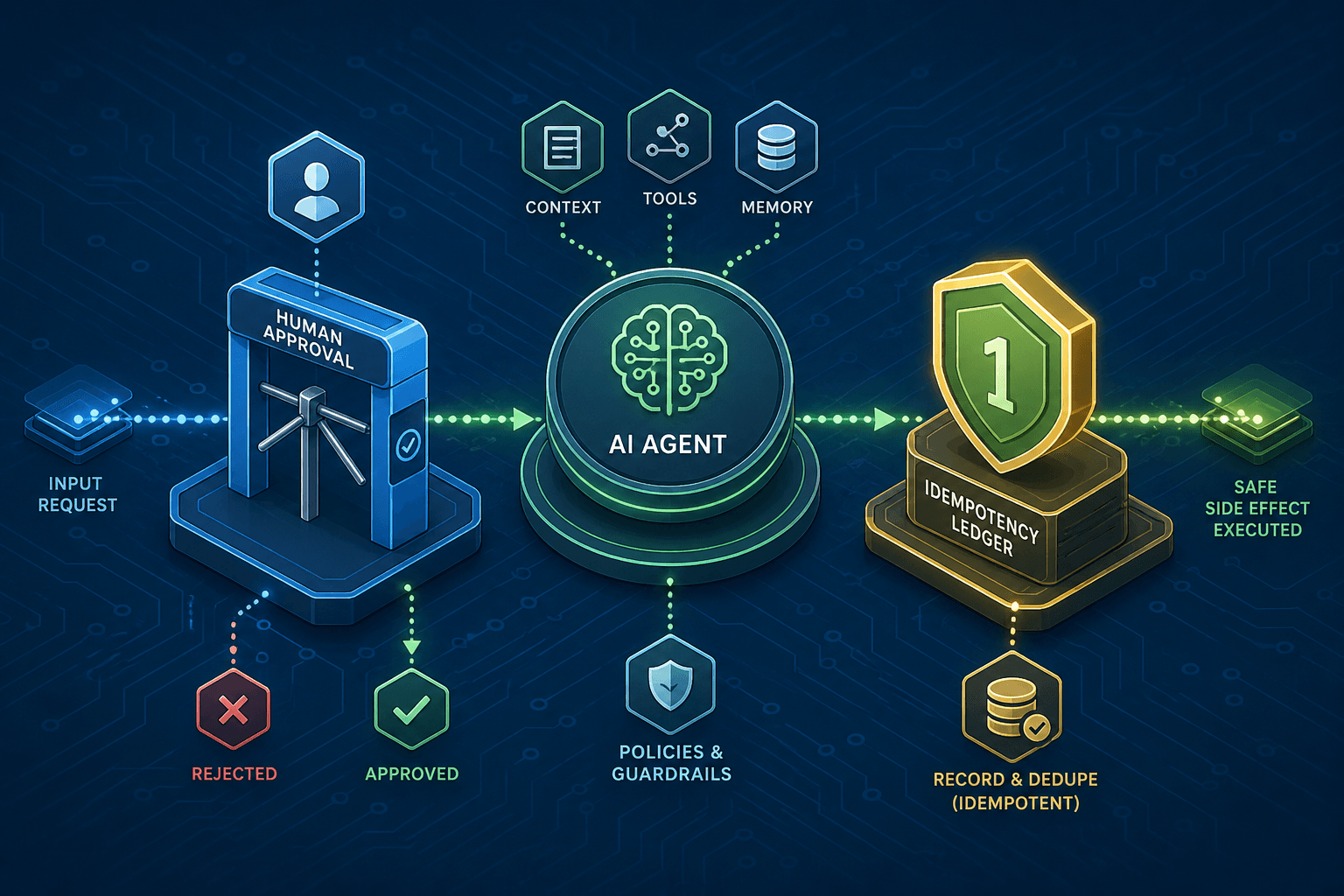
When we build AI agents, we often treat them like functions: input goes in, output comes out. But in production, agents are agents because they do things. They send emails, update CRM records, or trigger CI/CD pipelines. These are side effects. In traditional software, side effects are deterministic and reversible. In AI systems, the inputs are probabilistic, and the actions are often irreversible. This mismatch creates a specific class of failure modes that unit tests cannot catch. To build agents that survive contact with reality, we must implement two distinct but complementary mechanisms: human-in-the-loop (HITL) approval gates and strict idempotency for side-effect execution.
The Danger of Probabilistic Side Effects
Consider an agent designed to manage customer support tickets. One of its tools is send_refund_email. In a deterministic system, if you call this function twice with the same arguments, you get two emails. That’s bad, but predictable. In an LLM-driven agent, the "arguments" are generated dynamically based on a conversation context.
If the network times out after the agent decides to send a refund but before it records the success, a standard retry logic might re-execute the tool call. Without safeguards, the user receives two refunds. If the agent is acting on behalf of a company, this is a financial loss. If it’s acting on behalf of a user deleting a record, it’s data corruption.
The core problem is that LLMs are stateless predictors. They do not inherently understand the concept of "already done." They only understand probability. Therefore, the responsibility for safety shifts from the model to the orchestration layer. We need to enforce structure around the action, not just the intent.
Human-in-the-Loop as a Circuit Breaker
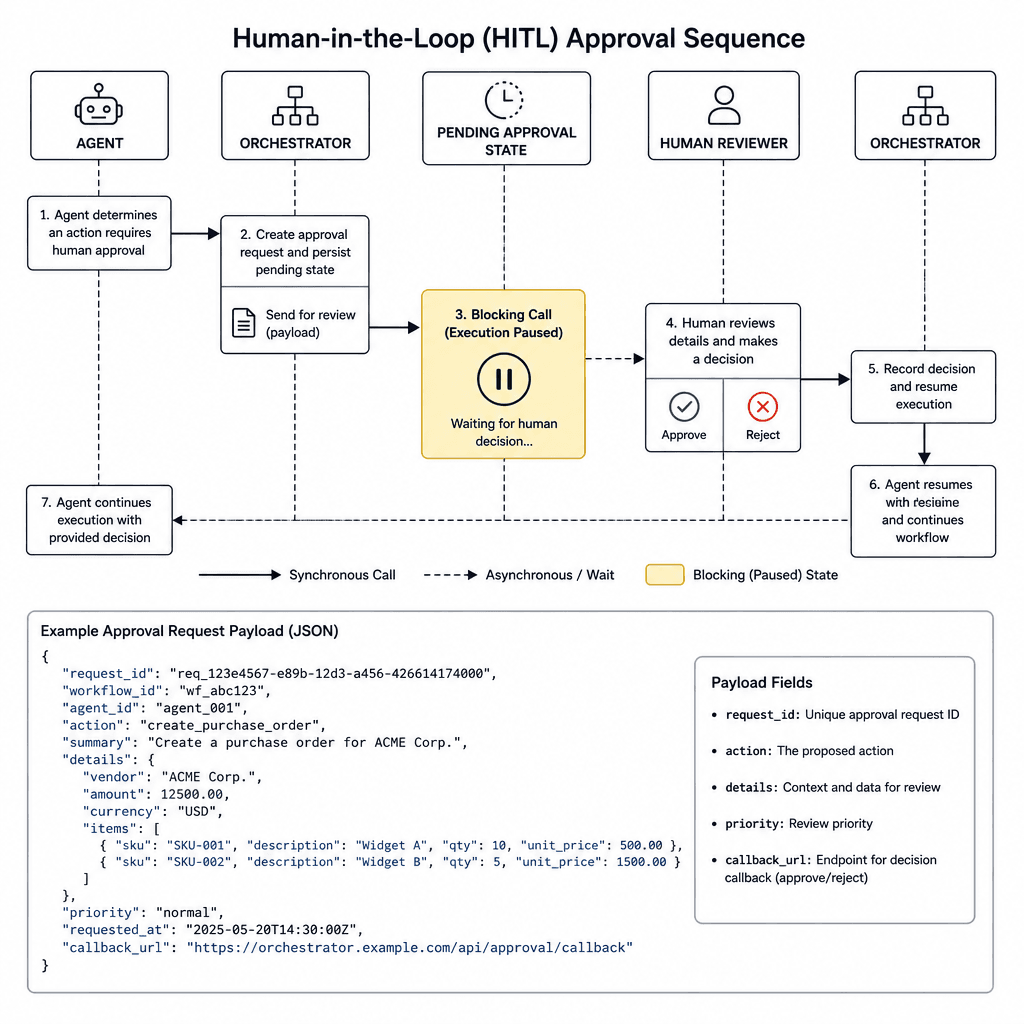
Human-in-the-loop is often misunderstood as a UX feature where a human clicks "approve" on a dashboard. In engineering terms, HITL is a synchronous blocking gate that pauses the agent’s execution thread until an external signal is received.
According to OWASP guidelines for AI security, human oversight is a recommended control for high-risk automated actions. HITL gates are essential for ensuring safe side effects by preventing unauthorized or erroneous actions from being executed. This is particularly critical when the agent’s probabilistic nature introduces uncertainty into high-stakes decisions.
Let’s look at a concrete scenario: An AI financial assistant detects an anomaly in a user’s spending pattern and recommends cancelling a subscription to a high-cost service. This is a "high-risk" action. The agent should not execute this automatically.
The mechanism works as follows:
- Intent Recognition: The agent’s planner identifies that the next step involves calling
cancel_subscription(service_id="premium_123"). - Risk Classification: The orchestrator checks a policy map. Actions involving financial transactions or data deletion are flagged as
requires_approval. - State Serialization: The current state of the conversation, the proposed action, and the rationale are serialized into a JSON payload. This payload is saved to a durable store (e.g., a database table
pending_approvals). - Blocking Call: The agent’s execution loop yields control. It does not proceed. It waits.
- Human Signal: A human reviews the payload via an API endpoint or UI. They approve or reject.
- Resume: The orchestrator updates the status of the pending approval. The agent resumes, reading the human’s decision as part of its context window.
Every HITL decision is captured in the audit log ai, creating a complete record of human intervention. This mechanism ensures that no side effect occurs without explicit authorization. It transforms the agent from an autonomous actor into a semi-autonomous one, where the human acts as a final validator for high-stakes transitions.
// Example: Pending Approval Payload
{
  "approval_id": "uuid-550e8400-e29b-41d4-a716-446655440000",
  "agent_session_id": "sess_abc123",
  "proposed_action": {
    "tool": "cancel_subscription",
    "args": { "service_id": "premium_123" }
  },
  "rationale": "User requested cancellation due to unexpected charge.",
  "status": "pending",
  "created_at": "2023-10-27T10:00:00Z"
}
Idempotency: The Safety Net for Network Chaos
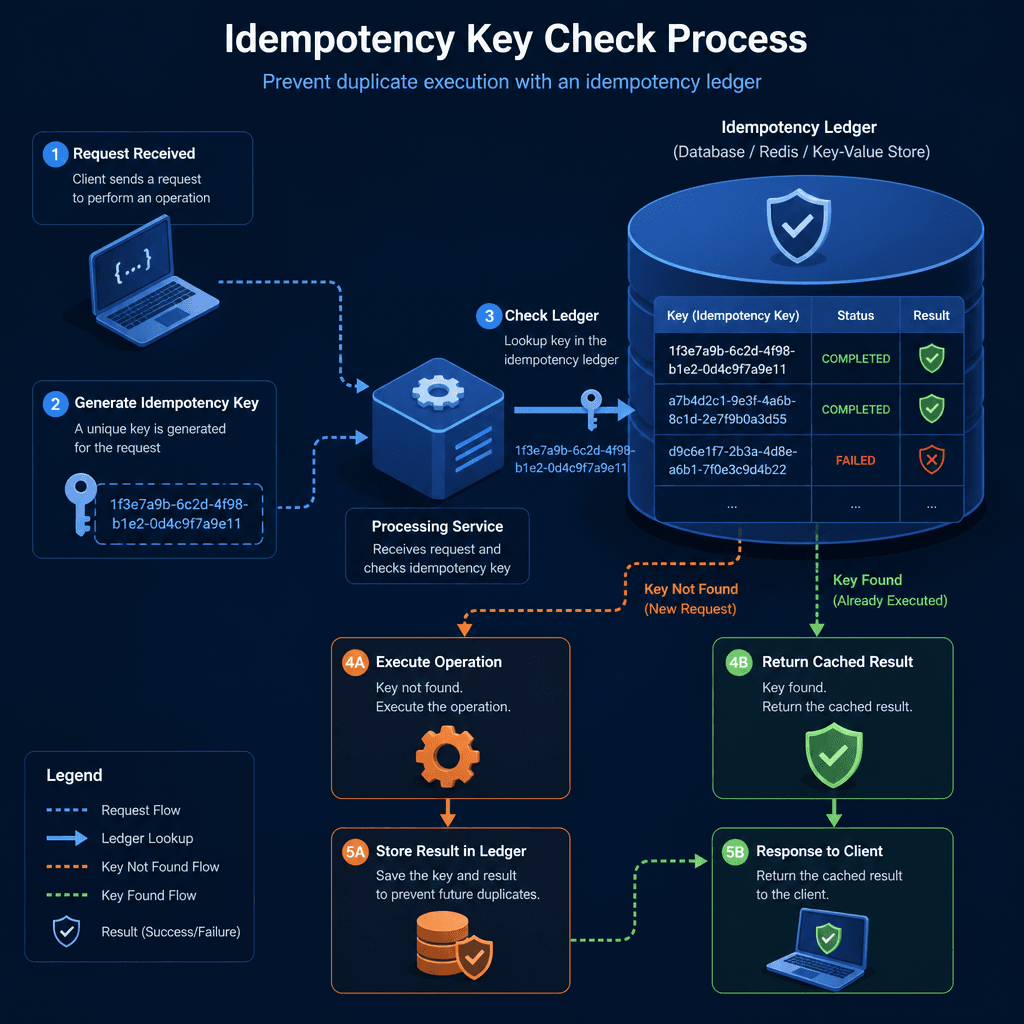
Even with HITL, systems fail. Networks drop packets. APIs timeout. Orchestration frameworks may retry steps due to transient errors. If the human approves the action, and the agent sends the HTTP request, but the response is lost, a naive retry will send the request again.
As defined in RFC 7231, idempotency ensures that multiple identical requests have the same effect as a single request. This principle is the foundation of reliable distributed systems. For side effects, this usually means using an Idempotency Key.
An idempotency key is a unique identifier (typically a UUID) generated by the agent before it attempts the action. This key is passed to the external service or recorded in an internal ledger. The idempotency key is also recorded in the audit log ai, providing a clear marker of attempted vs. executed actions.
Here is the mechanism:
- Key Generation: When the agent prepares to execute
send_refund_email, it generates a UUID:idemp_key_999. - Ledger Check: Before calling the external API, the agent checks a local or distributed ledger (e.g., Redis or PostgreSQL) for
idemp_key_999. - Execution or Return:
- If the key exists and the status is
success, the agent returns the previous result immediately without making the HTTP call. - If the key does not exist, the agent makes the HTTP call, stores the key with status
in_progress, and upon success, updates the status tosuccess.
- If the key exists and the status is
- Failure Handling: If the call fails, the key remains in a
failedstate. The agent can retry, but the ledger prevents double-execution.
This ensures that even if the agent loops, crashes, or retries, the side effect happens exactly once. This is critical for compliance and data integrity.
The Audit Trail: Connecting Decisions to Actions
HITL and idempotency are technical controls. The audit trail is the evidence that these controls were followed. In regulated industries, an audit log ai system is not just best practice but a compliance requirement. As outlined in NIST guidelines for AI risk management, maintaining an immutable audit trail is critical for accountability.
A robust audit log should capture three layers of information:
- The Intent: The LLM’s reasoning. Why did the agent decide to call this tool?
- The Control: The HITL decision. Who approved it? Was it auto-approved by policy or manually reviewed?
- The Execution: The technical outcome. Did the idempotency key prevent a duplicate? What was the API response?
By linking the approval_id from the HITL step with the idempotency_key from the execution step, you create an immutable chain of custody. This allows you to reconstruct the entire lifecycle of an action during post-mortems or compliance audits. To ensure integrity, audit logs should be stored in append-only formats or WORM (Write Once, Read Many) storage, preventing retroactive alteration. Access to these logs should be strictly role-based, limited to compliance officers and system administrators, ensuring that the history of agent actions remains tamper-proof and verifiable.
# Pseudocode for Idempotent Execution with Audit
def execute_tool_with_safety(tool_call, agent_state):
    # 1. Retrieve Idempotency Key
    idemp_key = tool_call.idempotency_key

    # 2. Check Ledger
    existing = ledger.get(idemp_key)
    if existing and existing.status == 'success':
        log_audit(idemp_key, "RETRY_SKIP", existing.result)
        return existing.result

    # 3. Check HITL Approval
    if tool_call.risk_level == 'HIGH':
        approval = hitl_wait_for_approval(tool_call)
        if not approval.approved:
            raise PermissionError("Human rejected action")

    # 4. Execute Action
    try:
        result = call_external_api(tool_call.args)
        ledger.put(idemp_key, status='success', result=result)
        log_audit(idemp_key, "EXECUTED", result)
        return result
    except Exception as e:
        ledger.put(idemp_key, status='failed', error=str(e))
        log_audit(idemp_key, "FAILED", str(e))
        raise
Conclusion
Building reliable AI agents requires moving beyond prompt engineering. You must engineer the workflow around the agent. Human-in-the-loop provides the semantic safety net, ensuring that high-stakes actions have human oversight. Idempotency provides the technical safety net, ensuring that the system’s behavior is consistent despite network failures and retries. Together, they transform AI agents from probabilistic chaos engines into deterministic, auditable, and safe production systems.
This audit trail is the primary mechanism for verifying safe side effects in production. Without these mechanisms, you are not building an agent; you are building a source of unpredictable liability.
Related posts
Durable Execution for Agents with Temporal
Explore how Temporal enables durable execution for AI agents, ensuring resilience through checkpointing and replay mechanisms.
Computer-Use Agents: Architecture and Limits
An examination of computer-use agent architecture, focusing on GUI agents, screenshot processing, accessibility trees, and browser automation limits.
Building a Deep Research Agent: Multi-Agent Guide
A technical walkthrough for ML engineers on constructing a multi-agent research system that handles synthesis and citations.
