Single Logout vs Universal Logout
Examines the differences between Single Logout and Universal Logout in SSO systems, focusing on session termination and incident response for identity engineers.
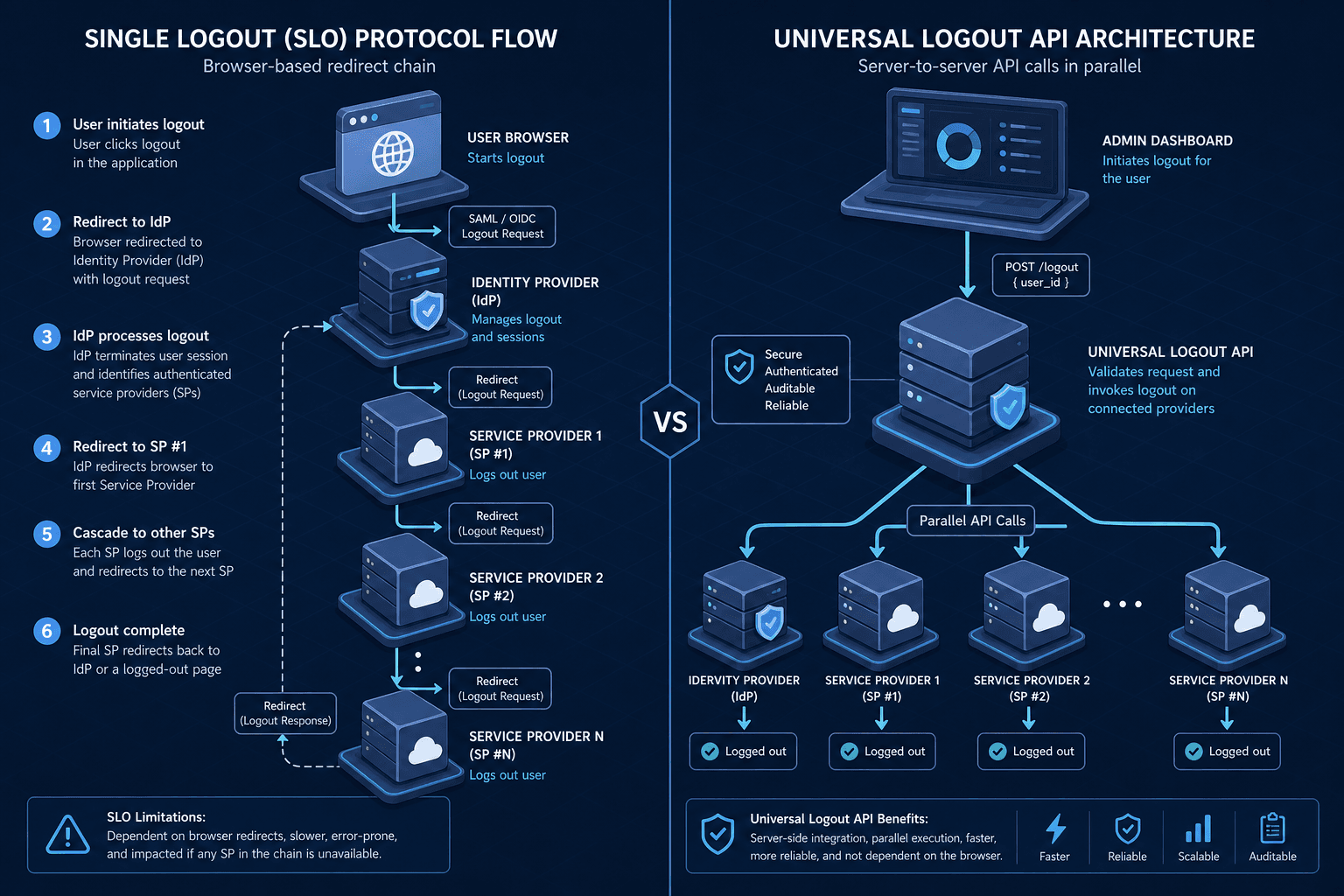
In Single Sign-On (SSO) architectures, the term "logout" is often used interchangeably, but technically, it refers to two distinct mechanisms with vastly different reliability profiles. Single Logout (SLO) is a protocol-level handshake defined by SAML and OpenID Connect (OIDC) that attempts to propagate a user's exit from one service to all others. Universal Logout is an architectural pattern where an application explicitly invokes termination APIs across all connected identity providers and service providers, independent of the user's browser session.
For identity engineers, understanding this distinction is critical. SLO is designed for user convenience; Universal Logout is designed for security incident response. This article examines why relying solely on protocol-level logout mechanisms can leave organizations vulnerable and how Universal Logout provides the deterministic session invalidation required for resilient security operations.
The Fragility of SLO
Single Logout operates on a synchronous chain of trust. When a user clicks "Sign Out" on a Service Provider (SP), the SP redirects the user's browser back to the Identity Provider (IdP) with a logout request. The IdP then collects responses from all other SPs (or waits for timeouts) and only then invalidates its own session.
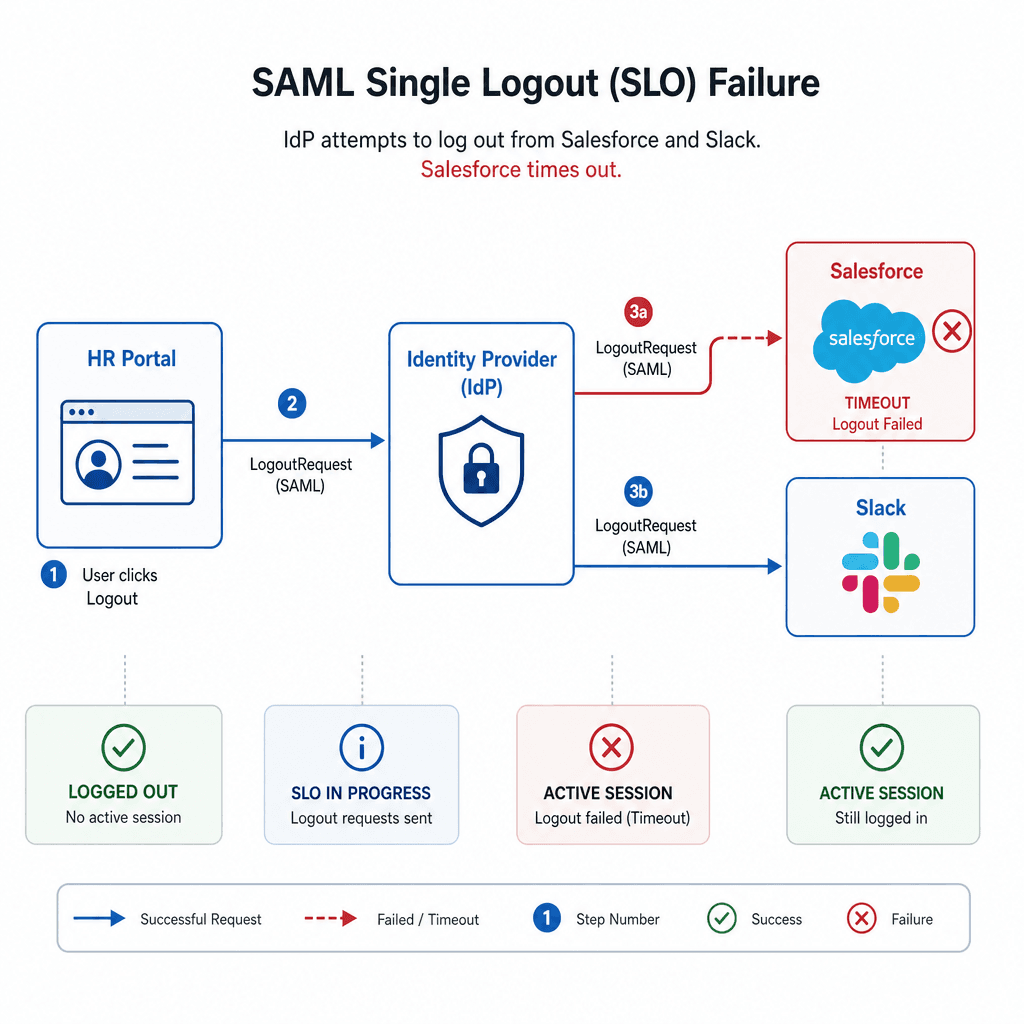
This mechanism is fragile because it relies on the availability of every single SP in the chain. If one SP is unreachable due to a network partition, firewall rule change, or downtime, the IdP cannot complete the SLO handshake. Depending on the implementation, the IdP may either:
- Hang until a timeout occurs, delaying the user's final redirection.
- Fail the entire SLO process, leaving the user logged into all other active SPs.
- Proceed with the SPs that responded, leaving the failed SPs in an inconsistent state.
Consider a corporate environment using SAML SSO. An employee logs into Salesforce, Slack, and an internal HR portal. They click "Sign Out" on the HR portal. The HR portal sends a SAML LogoutRequest to the IdP. The IdP acknowledges and sends LogoutRequests to Salesforce and Slack. If Salesforce is experiencing high latency or a temporary outage, the IdP may timeout the request. The user is redirected back to the HR portal, believing they are logged out. However, their session cookies on Salesforce and Slack remain valid. They can still access sensitive data by directly visiting those URLs. This is a "partial logout" failure, a common source of security confusion.
The Mechanics of Universal Logout
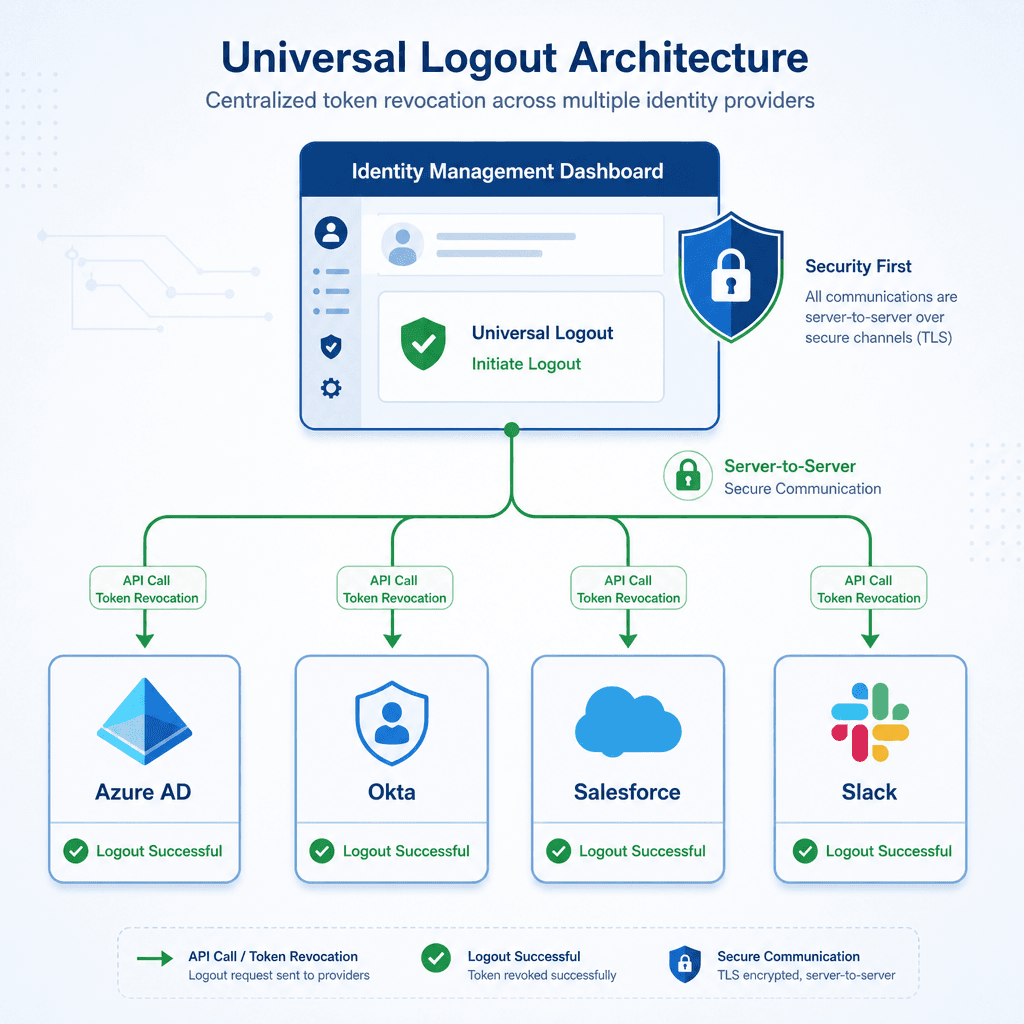
Universal Logout decouples session termination from the browser-based SSO flow. Instead of relying on the IdP to orchestrate the exit, the application (or a central admin system acting on behalf of the user/tenant) takes direct responsibility for invalidating sessions across all connected systems. This is typically achieved through server-side API calls.
In an OIDC context, this often involves calling the end_session_endpoint provided by the IdP, or using specific tenant management APIs to revoke refresh tokens and access tokens. In SAML, it may involve sending explicit logout requests via SOAP bindings directly from the backend, bypassing the browser.
The key difference is directionality and control. SLO is user-initiated and browser-driven. Universal Logout is system-initiated and server-driven. This makes Universal Logout deterministic. If the HR system triggers a Universal Logout, it iterates through a list of known SPs and IdPs and calls their respective termination endpoints. If one endpoint fails, the system can log the error and continue, or retry, ensuring that the majority of sessions are terminated.
For example, a security engineer detecting a compromised credential might trigger a Universal Logout from the central identity management dashboard. This action sends a batch of API requests to Azure AD, Okta, Google Workspace, and various SAML SPs. Each provider independently invalidates the user's tokens and sessions. The user is immediately logged out everywhere, regardless of whether their browser is still open or whether they have active tabs on other sites.
Incident Response and Blast Radius
The primary value of Universal Logout is in incident response. SLO is a user experience feature; Universal Logout is a security control.
When a security breach is detected, time is critical. Relying on the user to notice the compromise and click "Sign Out" on their most frequently used application is unreliable. Even if they do, SLO may fail to log them out of all systems. Universal Logout allows the security team to execute a "kill switch" for a compromised identity. This minimizes the blast radius by ensuring that no active sessions remain on any connected system.
Furthermore, Universal Logout supports "session revocation" at the token level. Many modern IdPs provide APIs to revoke all refresh tokens for a user. However, effective session termination requires BOTH invalidating server-side sessions/tokens AND clearing client-side state (cookies/local storage). This is more effective than simply clearing browser cookies, which SLO typically relies on but often fails to coordinate reliably.
Implementation Tradeoffs
Implementing Universal Logout requires additional complexity. The application must maintain an accurate inventory of all connected SPs and IdPs. It must handle the asynchronous nature of these API calls, potentially queuing requests and handling retries. It must also manage the security implications of having an admin interface that can trigger mass logout events, which could be a denial-of-service vector if misused.
However, for enterprises with strict security requirements, the tradeoff is justified. SLO should still be implemented for user convenience, but Universal Logout should be the primary mechanism for security-critical session termination.
Conclusion
Single Logout and Universal Logout serve different purposes. SLO is a protocol-based, user-driven attempt to keep sessions in sync across browsers. Universal Logout is an application-driven, server-based strategy for absolute session invalidation. Identity engineers should design systems that support both, recognizing that Universal Logout is the only reliable method for ensuring complete session termination during a security incident. By decoupling session termination from the browser flow, organizations can ensure that when a threat is detected, the response is immediate, complete, and under their control.
Related posts
SAML Single Logout (SLO): The Mechanics of Session Termination
A technical examination of SAML Single Logout (SLO) mechanisms, covering front-channel and back-channel flows, session index handling, and protocol compliance for identity engineers.
SAML 2.0 in One Diagram
A visual walkthrough of the SAML 2.0 Single Sign-On flow, covering bindings, profiles, and how it compares to OIDC.
SAML Metadata Exchange and Trust Establishment
A technical examination of SAML metadata exchange, covering trust establishment, entity descriptors, certificate rollover, and metadata refresh mechanisms.
