TensorRT-LLM: When the Extra Build Complexity Pays Off
An examination of TensorRT-LLM's engine build process and how the initial complexity delivers significant throughput gains for NVIDIA hardware.
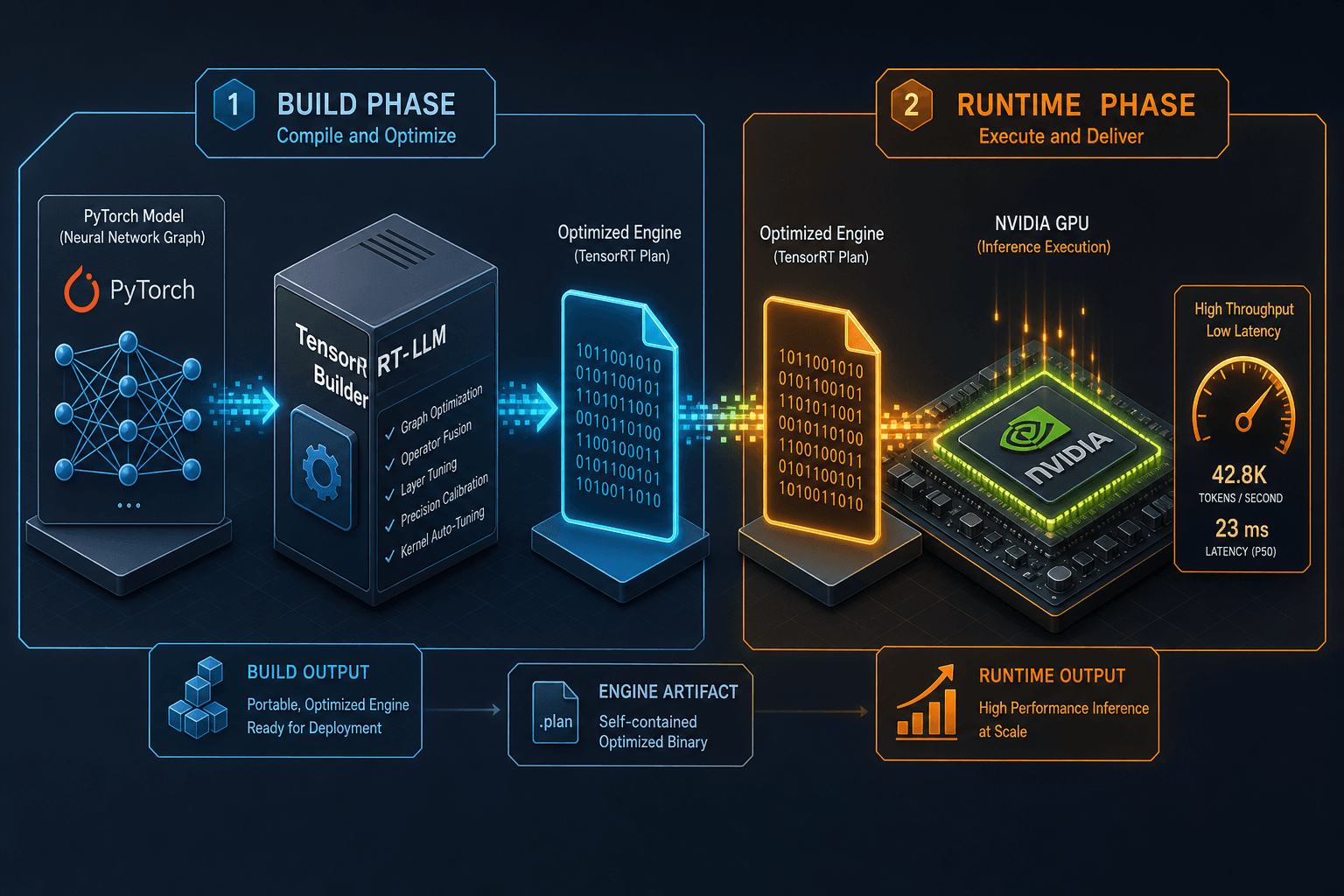
For machine learning engineers, the standard workflow for deploying large language models (LLMs) often feels linear: load the weights, compile the graph, and serve. Frameworks like Hugging Face Transformers or vLLM abstract away much of the hardware-specific tuning, offering ease of use at the cost of raw peak performance. TensorRT-LLM (TRT-LLM), however, inverts this model. It demands a distinct, computationally expensive build phase before inference can even begin. This separation of concerns—building an optimized engine separately from serving it—is not just bureaucratic overhead; it is a mechanism for shifting optimization costs from the critical path of request handling to a one-time setup phase. The result is significantly higher throughput and lower latency on NVIDIA hardware, provided the engineering team can absorb the initial complexity.
The Build Mechanism: Graph Fusion and Kernel Selection
The core value proposition of TRT-LLM lies in its build process, which transforms a high-level model definition (typically in PyTorch) into a highly optimized, hardware-specific serialized engine. Unlike eager execution frameworks that execute operations one by one, TRT-LLM performs static analysis of the computational graph during the engine build.
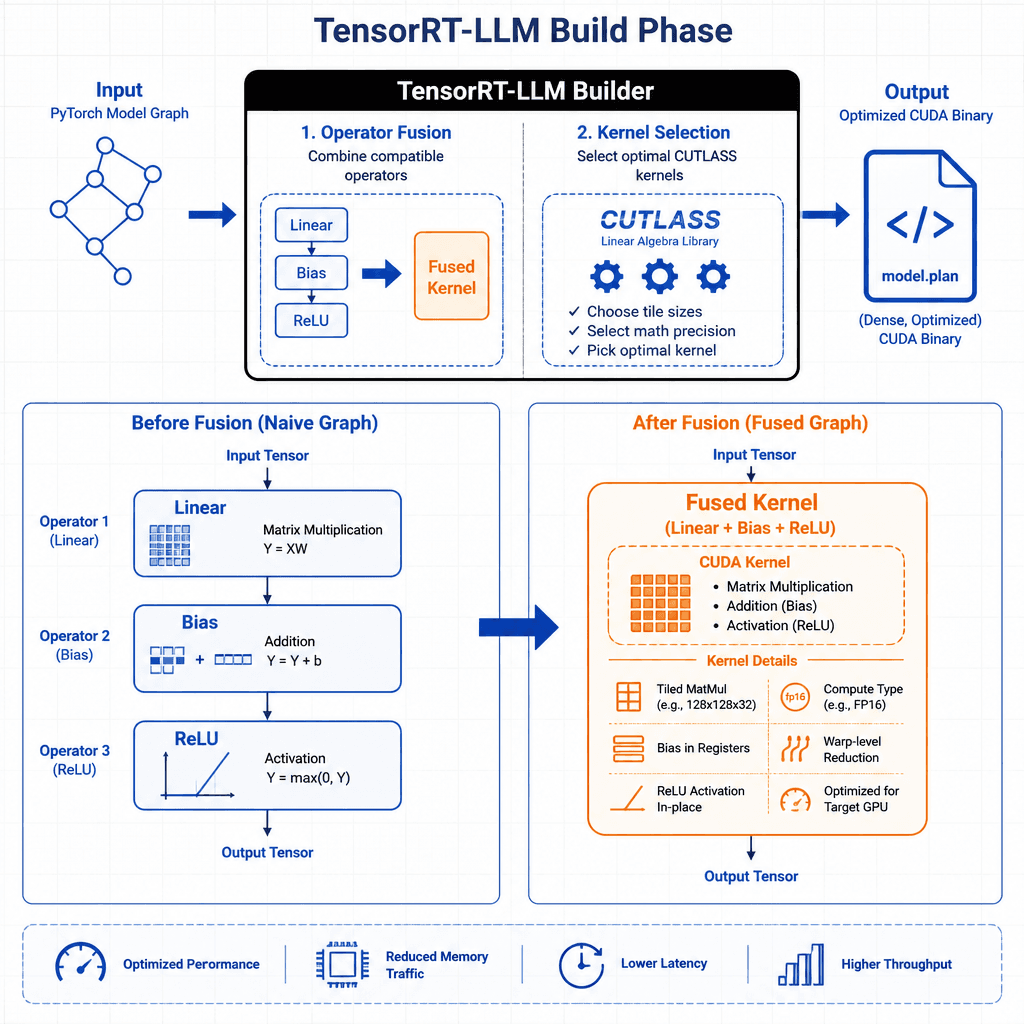
During the build phase, TensorRT-LLM identifies patterns in the model architecture, such as matrix multiplications, attention mechanisms, and activation functions. It then leverages NVIDIA’s CUTLASS library to select or generate optimal CUDA kernels for these operations. CUTLASS provides a modular framework for implementing high-performance linear algebra operations, allowing TRT-LLM to tune block sizes, register usage, and shared memory configurations based on the specific GPU architecture (e.g., H100, A100).
Furthermore, TRT-LLM employs operator fusion. In a naive implementation, intermediate results between layers are written to global memory and read back, creating a bottleneck. TRT-LLM fuses multiple operations into single kernels. For example, it might combine a linear projection, a bias addition, and a ReLU activation into one CUDA kernel. This reduces memory bandwidth pressure and increases arithmetic intensity, allowing the GPU’s compute units to stay busy longer.
This process is not trivial. The build can take hours for large models, as TRT-LLM searches through a space of possible optimizations, including precision choices (FP16, BF16, FP8, INT8) and tensor parallelism strategies. However, this complexity is amortized over the lifetime of the deployment. The resulting engine contains all the logic necessary to execute the model without needing to re-analyze the graph or select kernels at runtime.
Memory Optimization: Paged Attention and KV Cache Management
Beyond compute optimization, TRT-LLM addresses one of the most significant bottlenecks in LLM inference: memory management for the Key-Value (KV) cache. As the model generates tokens, it must store the hidden states of previous tokens to attend to them in subsequent steps. This KV cache grows linearly with sequence length and batch size, often becoming the limiting factor for throughput.
Traditional implementations allocate contiguous blocks of memory for the KV cache, which leads to fragmentation and inefficient utilization. TRT-LLM integrates PagedAttention, a technique inspired by virtual memory management in operating systems. Instead of allocating contiguous blocks, PagedAttention treats the KV cache as a set of pages. These pages can be stored in non-contiguous memory locations and linked together, similar to how hard drives manage files. This approach to GPU optimization allows for more efficient memory usage compared to other frameworks that might rely on Triton-based kernel implementations without such advanced paging mechanisms.
This approach offers two major advantages. First, it eliminates memory fragmentation, allowing more sequences to be packed into the available GPU memory. Second, it enables dynamic batching of requests with different sequence lengths without wasting memory. The build phase configures the engine to use this paging scheme, optimizing the memory layout for the specific GPU’s memory hierarchy.
The result is a substantial increase in the maximum batch size that can be handled simultaneously. For long-context models, this can mean the difference between serving a few users or hundreds, directly impacting the cost-efficiency of the deployment.
Runtime Execution: Eliminating Compilation Overhead
The final piece of the puzzle is the runtime experience. When a TRT-LLM engine is built, it includes a serialized plan that describes exactly how to execute the model. At inference time, the engine simply loads this plan and executes it. There is no need for just-in-time (JIT) compilation or graph optimization during request handling.
In contrast, frameworks like PyTorch with TorchCompile may perform graph compilation on the first few requests, introducing latency spikes. TRT-LLM’s approach ensures consistent latency from the very first token. The engine also manages tensor parallelism and pipeline parallelism internally, distributing the workload across multiple GPUs seamlessly. This consistency is crucial for production environments where predictable latency is as important as throughput, directly contributing to improved overall throughput metrics.
This consistency is crucial for production environments where predictable latency is as important as throughput. The build complexity pays off by providing a stable, high-performance runtime that does not degrade under load due to dynamic optimization overheads.
Conclusion
TensorRT-LLM’s build complexity is a deliberate trade-off. By investing time in building an optimized engine, engineers gain a runtime that is faster, more memory-efficient, and more predictable than general-purpose frameworks. For high-throughput LLM inference deployments on NVIDIA hardware, this investment is justified. The key is recognizing that the build phase is not a barrier but an optimization opportunity, transforming variable runtime costs into fixed setup costs.
Related posts
SGLang's RadixAttention, Explained
An examination of SGLang's RadixAttention mechanism, focusing on prefix caching, radix trees, and throughput optimization for ML infrastructure.
Unsloth: Fine-Tuning 2x Faster on One GPU
Learn how Unsloth accelerates fine-tuning by 2x using Triton kernels and LoRA, enabling efficient model training on a single GPU.
Running LLM Inference on AMD MI300X: A Field Report
A field report on running LLM inference using AMD MI300X, ROCm, and vLLM, evaluating performance as a GPU alternative.
