Structured Output and Guided Decoding in vLLM
Explore guided decoding and structured output techniques in vLLM to ensure reliable JSON and grammar-constrained generation for backend and ML applications.
In production LLM applications, the gap between "getting the answer" and "getting a usable answer" is often bridged by parsing. Backend engineers expect strict JSON objects, SQL queries, or specific configuration formats. Without constraints, LLMs are probabilistic engines that may hallucinate syntax, omit commas, or wrap strings in inconsistent quotes. Post-processing parsers (like pydantic or json.loads) can catch these errors, but they fail when the LLM generates fundamentally broken structure, requiring costly retries.
Integrating vLLM with external constraint engines like xgrammar or Outlines enables guided decoding. This technique enforces strict output formats by intersecting the model’s probability distribution with a predefined grammar or schema at every token generation step. Instead of hoping the LLM stays on track, guided decoding mathematically forces it to comply.
The Mechanism of Constraint
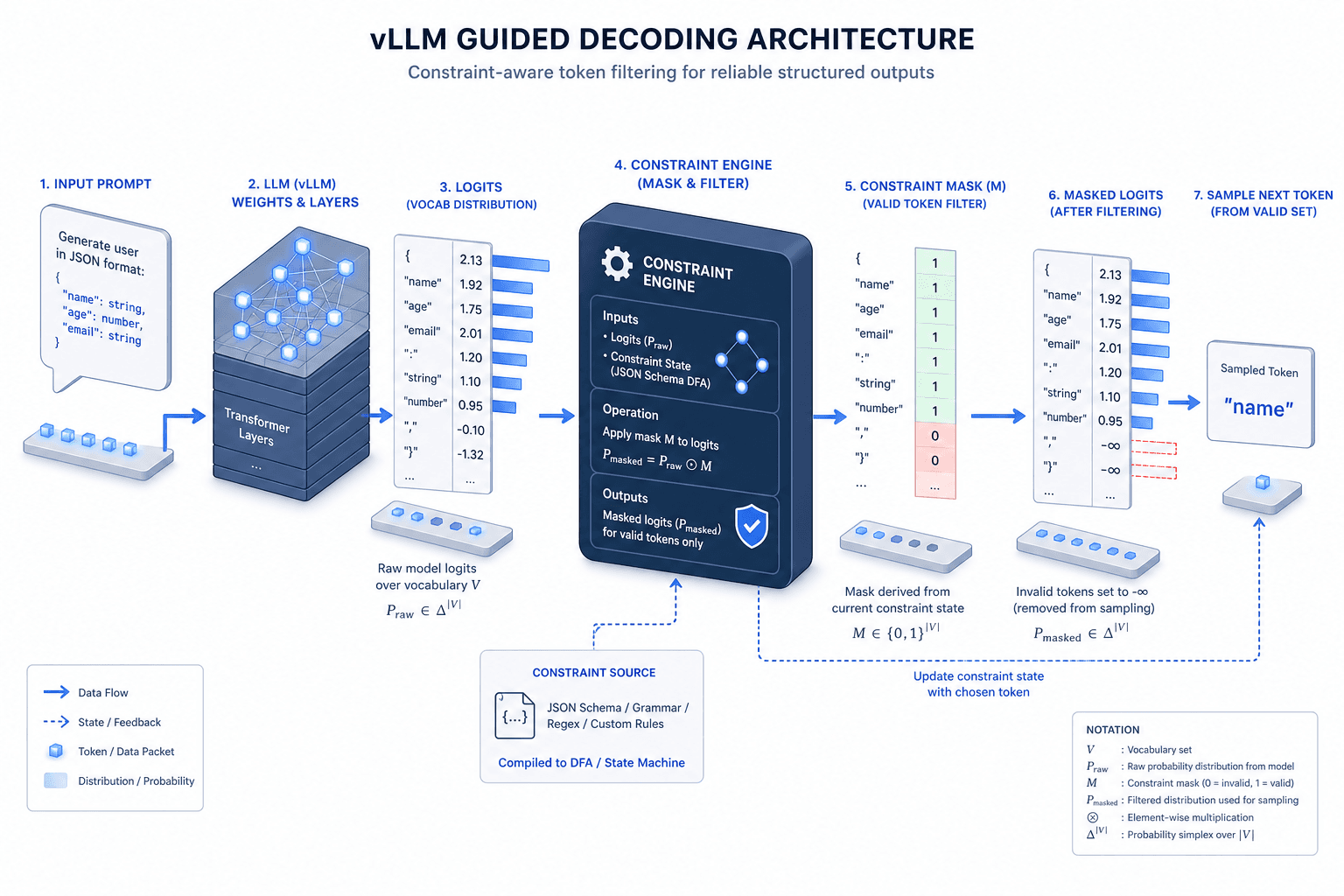
guided decoding works by injecting a constraint engine into the decoding loop. Normally, an LLM calculates logits (raw prediction scores) for every token in its vocabulary, applies a softmax function to get probabilities, and samples the next token.
Here is the mechanism:
- Logit Interception: Before sampling, vLLM intercepts the raw logits tensor.
- Mask Application: The constraint engine (e.g.,
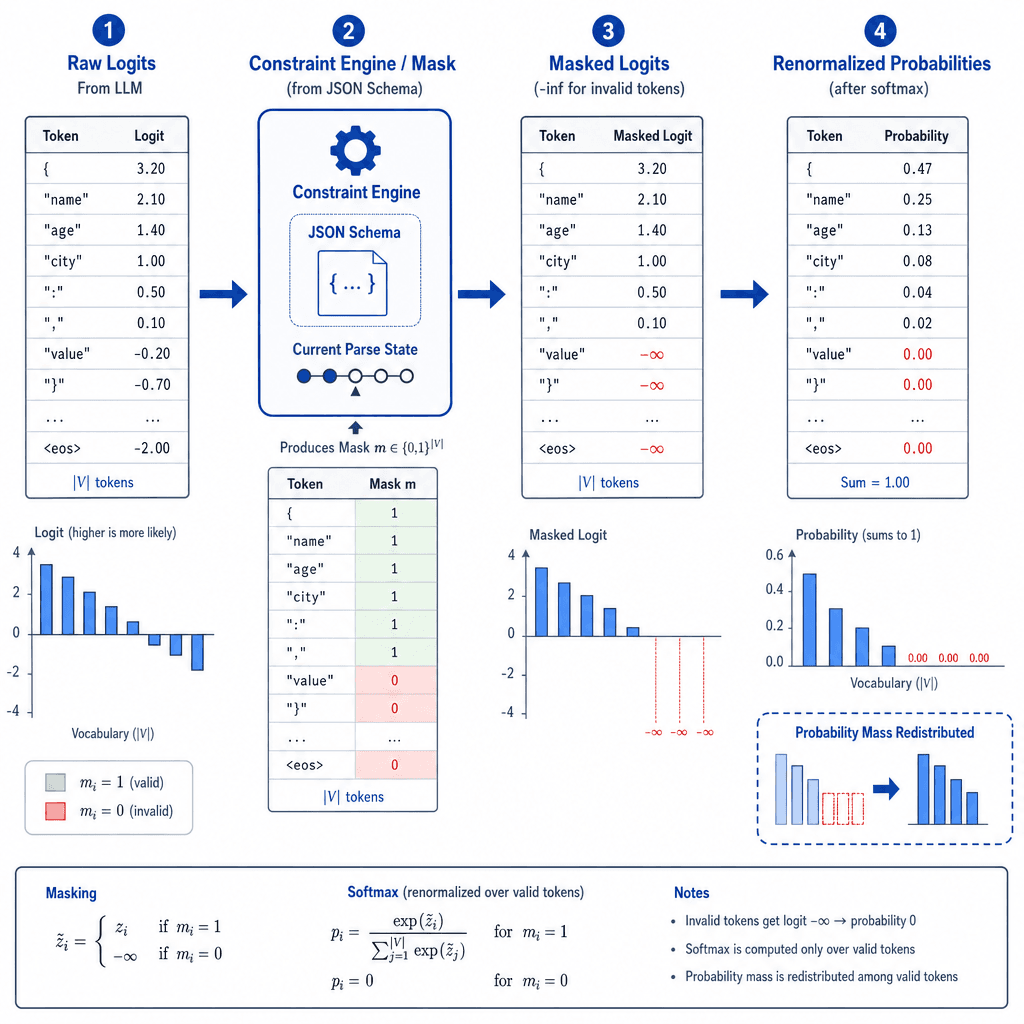
xgrammar) analyzes the current context and the target schema (JSON or EBNF). It determines which tokens are valid next steps. Invalid tokens are assigned a logit value of negative infinity (). - Renormalization: The softmax function is applied again to the masked logits. Since invalid tokens now have zero probability, the total probability mass redistributes among the valid tokens.
- Sampling: The model samples from this narrowed distribution.
This process ensures that every generated token is syntactically valid according to the constraint. It transforms generation from a stochastic process into a constrained search problem. It is important to note that while guided decoding ensures syntactic validity of the generated token sequence locally, it does not guarantee global consistency across distributed replicas without external coordination.
JSON Schema Enforcement
guided decoding is most commonly used for generating valid JSON. vLLM allows you to pass a JSON Schema directly to the SamplingParams. The underlying engine, typically xgrammar, compiles this schema into a finite state machine (FSM) or a context-free grammar (CFG) on the fly.
Implementation Example
from vllm import LLM, SamplingParams
from pydantic import BaseModel
import json

# Define your expected structure
class Person(BaseModel):
    name: str
    age: int
    is_employed: bool

# Generate the JSON schema from Pydantic model
json_schema = json.dumps(Person.model_json_schema())

# Initialize vLLM
llm = LLM(model="meta-llama/Meta-Llama-3-8B-Instruct")

# Configure guided decoding
sampling_params = SamplingParams(
    temperature=0.0,  # Deterministic sampling
    guided_decoding={
        "json": json_schema  # Enforce this specific schema
    }
)

# Generate
outputs = llm.generate(
    "Extract info about John Doe, 30, employed.",
    sampling_params
)

print(outputs[0].outputs[0].text)
The guided_decoding={"json": ...} parameter tells vLLM to use the JSON schema constraint. Note that we set temperature=0.0. While guided decoding works at higher temperatures, it is most predictable in deterministic mode because the constraint dominates the sampling distribution.
Grammar-Based Generation
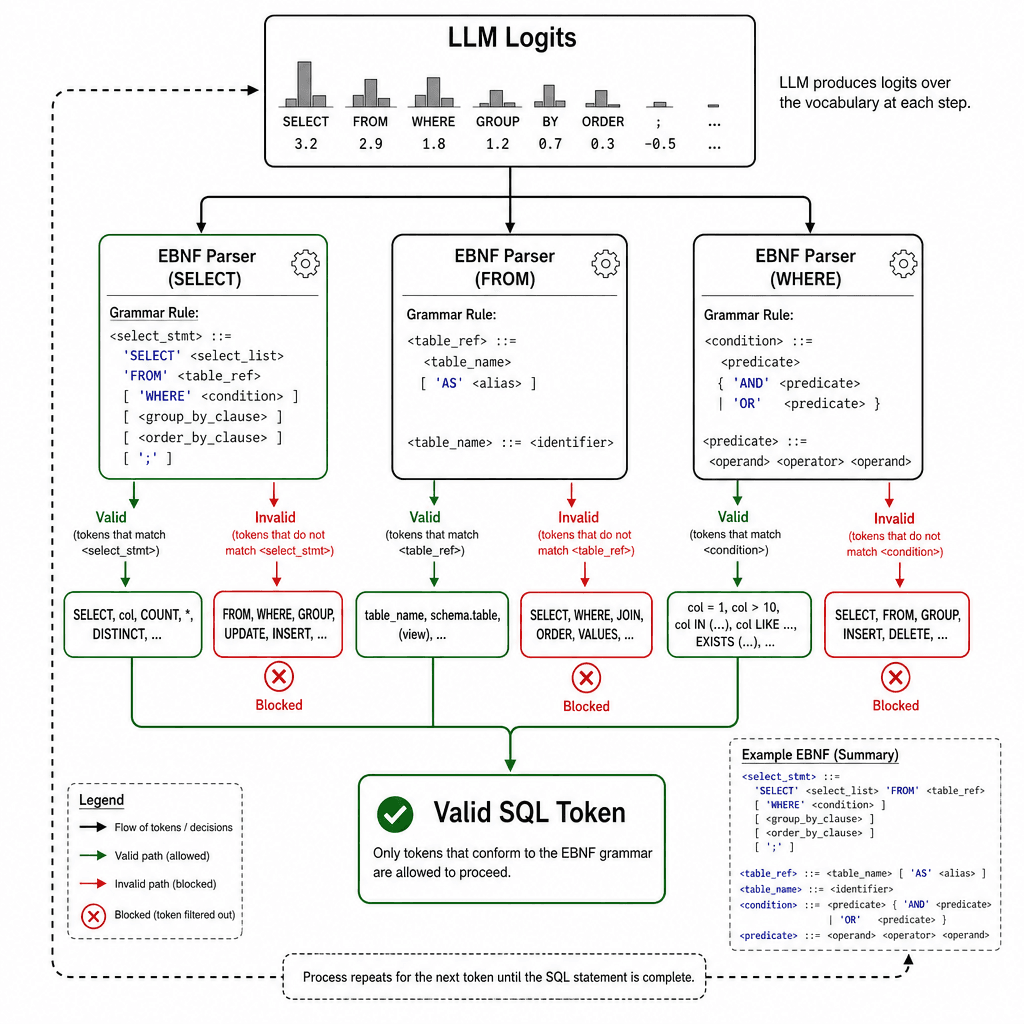
guided decoding also supports outputs that do not need to be JSON. For SQL queries, YAML configurations, or custom DSLs, JSON schemas are too restrictive. Here, EBNF (Extended Backus-Naur Form) grammars are used.
EBNF allows you to define the exact syntax rules of your target format. vLLM supports passing an EBNF string to the guided_decoding parameter.
Implementation Example
sampling_params = SamplingParams(
    temperature=0.0,
    guided_decoding={
        "grammar": """
        root ::= query
        query ::= "SELECT" column_list "FROM" table_name
        column_list ::= column | column_list "," column
        column ::= identifier
        table_name ::= identifier
        identifier ::= [a-zA-Z_]+[a-zA-Z0-9_]*
        """
    }
)
In this example, the LLM is forced to generate a syntactically valid SQL SELECT statement. If the model attempts to generate INSERT, the constraint engine masks out the INSERT token because it violates the root ::= query rule defined in the EBNF.
Production Tradeoffs
guided decoding introduces specific tradeoffs that backend engineers must consider.
Latency Overhead
Guided decoding adds computational overhead because the constraint engine must evaluate the grammar for every token. However, modern engines like xgrammar are highly optimized and cache previous states. Typical performance characteristics show a minimal latency penalty (often <5-10% increase) compared to the cost of the LLM inference itself. The benefit is a near-zero retry rate for format errors.
Memory Footprint
Compiling complex grammars can increase memory usage slightly due to the FSM representation. For extremely large schemas, this might impact batch size. However, for most JSON schemas and standard SQL grammars, the overhead is negligible.
Error Handling
Guided decoding guarantees syntactic validity, not semantic correctness. The LLM might generate a valid JSON object with incorrect data (e.g., "age": "thirty" instead of 30). You must still validate the content after generation. However, you eliminate the class of errors where the parser fails entirely due to missing brackets or malformed strings.
Conclusion
guided decoding in vLLM is not just a convenience; it is a production necessity for any application relying on structured LLM outputs. By shifting the burden of format validation from post-processing to the generation engine, it ensures reliability, reduces latency caused by retries, and simplifies downstream parsing logic. Whether you need strict JSON or custom EBNF structures, vLLM’s guided decoding provides the deterministic guarantees required for scalable ML systems.
Related posts
OWASP Top 10 for LLM Applications, Applied
A practical examination of the OWASP Top 10 for LLM Applications, covering security checklists, mitigations, and appsec review processes for developers.
Axolotl Configs Explained Line by Line
A detailed breakdown of Axolotl YAML configuration files for fine-tuning models with DeepSpeed and custom dataset formats.
Inference on Apple Silicon with MLX
A practical guide to running local machine learning inference on Apple Silicon using the MLX framework and unified memory architecture.
