Prefix Caching in vLLM: When It Wins and When It Doesn't
An examination of prefix caching in vLLM, analyzing when automatic prefix caching improves TTFT and cache hit rates, and when it may not provide benefits.
In large language model (LLM) inference, latency is the primary enemy of user experience. Two key metrics define this latency: Time To First Token (TTFT), which measures how long a user waits before seeing the first word of the response, and Tokens Per Second (TPS), which measures generation speed. While much attention is paid to optimizing TPS, TTFT is often the bottleneck for perceived responsiveness. Prefix caching is a critical optimization in vLLM designed to tackle this specific latency issue by reusing previous computations.
This is Part 4 of the Production vLLM series.
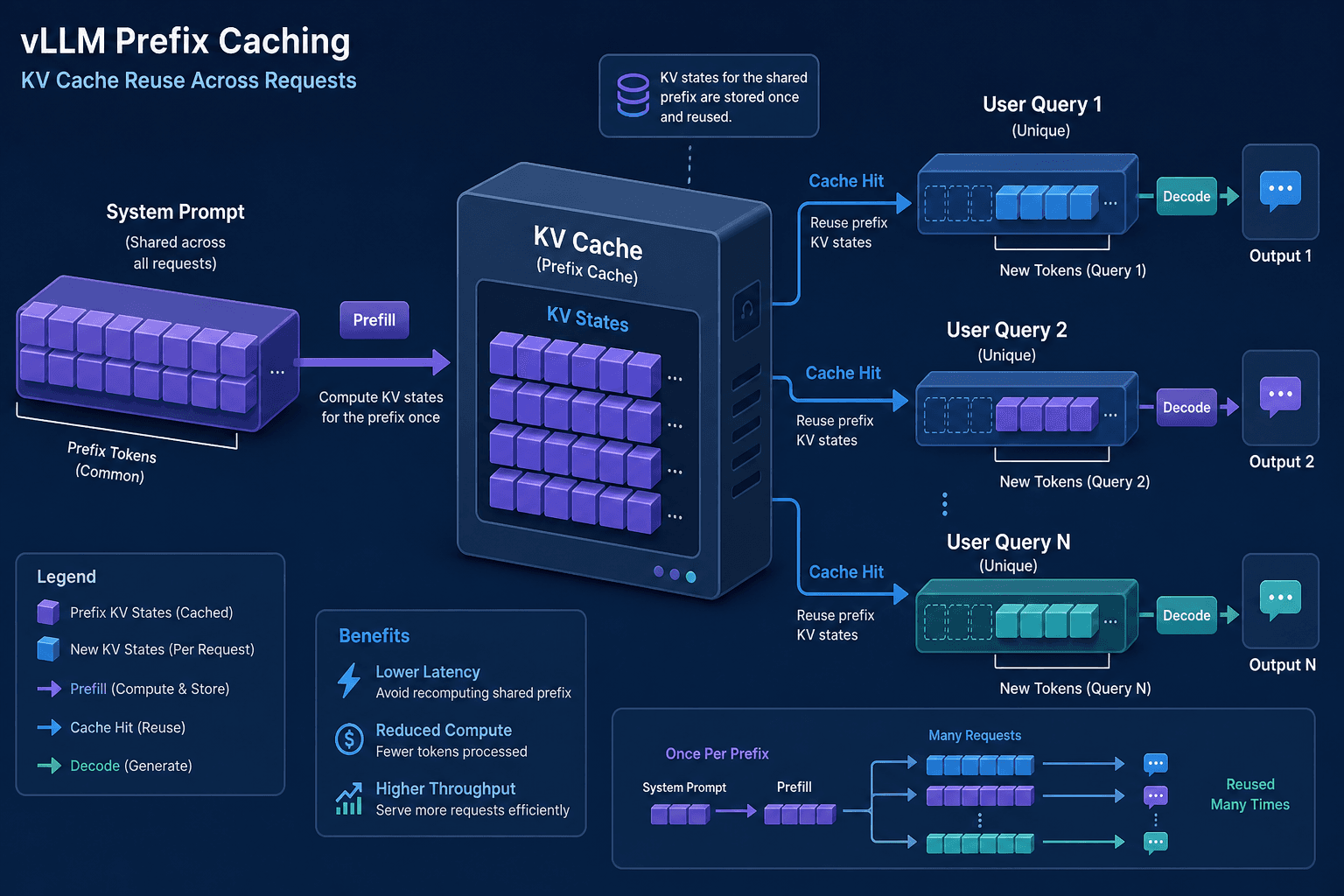
vLLM, a high-throughput inference engine, introduces prefix caching to tackle TTFT. This feature automatically caches the Key-Value (KV) states of previous requests. When a new request arrives with a matching prefix, vLLM reuses the cached KV states instead of recomputing them, significantly reducing the time required to process the prompt.
However, prefix caching is not a silver bullet. Its effectiveness depends entirely on the similarity of incoming requests and the available GPU memory. In this post, we dissect the mechanism of prefix caching in vLLM, analyze when it delivers substantial benefits, and identify scenarios where it offers little value or even introduces overhead.
The Mechanism of KV Cache Reuse
To understand prefix caching, one must first understand how LLMs process text. During the "prefill" phase, the model processes the entire input prompt to generate the first token. This involves computing attention scores for every token in the prompt. The results of these computations—specifically the Key and Value vectors—are stored in a structure called the KV cache.
During the subsequent "decode" phase, where the model generates tokens one by one, the KV cache is reused to avoid reprocessing the entire history of tokens. This saves significant computation during generation.
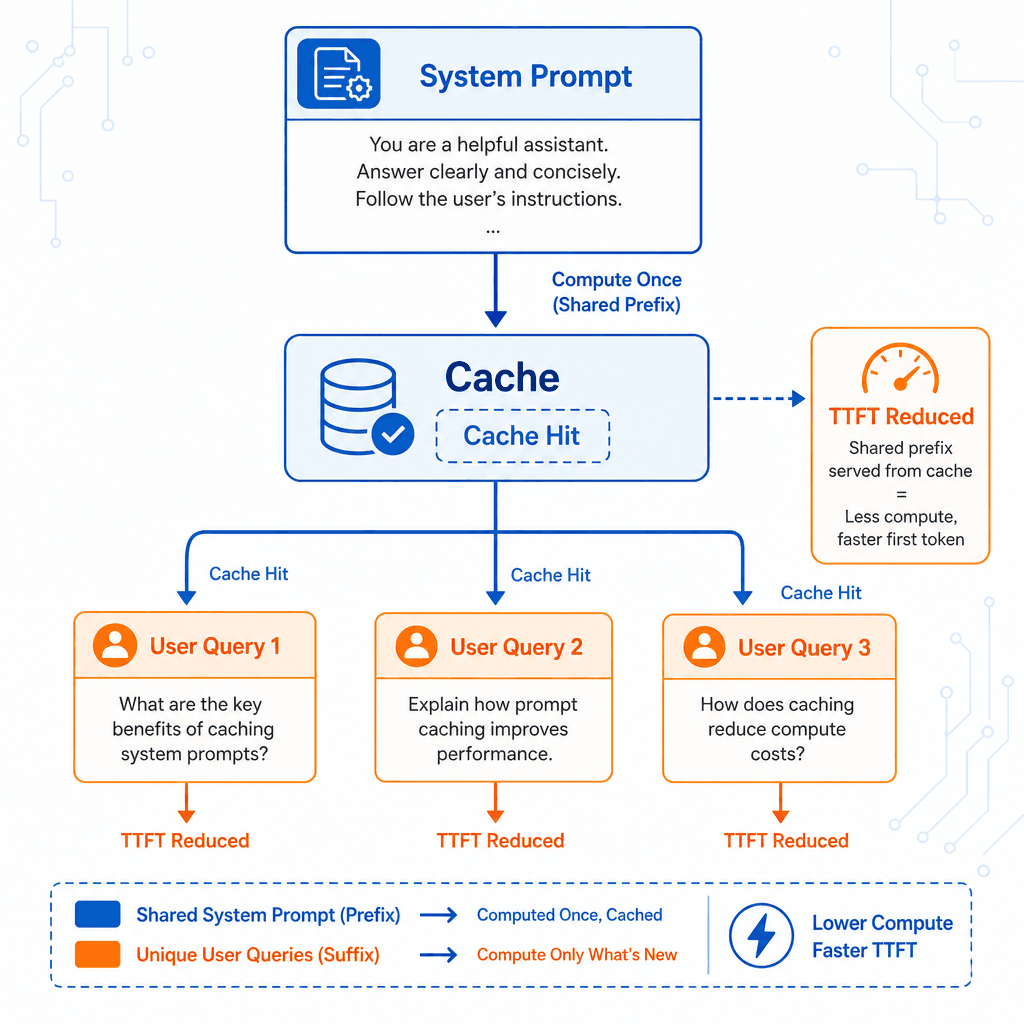
Prefix caching extends this concept across different requests. If Request A and Request B both start with the same sequence of tokens (the prefix), vLLM can store the KV cache computed for Request A’s prefix. When Request B arrives, vLLM checks if the prefix exists in the cache. If it does (a cache hit), vLLM loads the precomputed KV states and skips the expensive matrix multiplications associated with the prefix. It only computes the KV states for the unique suffix of Request B.
This mechanism relies on exact string matching of the prompt tokens. If the tokenized prefix matches exactly, the cache is valid.
When It Wins: High Similarity and Batched Workloads
Prefix caching shines in scenarios where multiple requests share a common prefix. The primary driver of benefit is the cache hit rate: the percentage of requests that successfully reuse cached prefixes.
1. Shared System Prompts
In chat-based applications, the system prompt is often long and identical for every user interaction. Consider a customer support bot with a 2,000-token system prompt instructing the AI to follow specific guidelines. Without prefix caching, every user query requires the model to process those 2,000 tokens from scratch. With prefix caching enabled, the KV cache for the system prompt is computed once and reused for thousands of subsequent requests. This can significantly reduce TTFT for the initial processing step.
2. Batched Requests with Common Headers
In API contexts, requests often include common metadata or headers that are tokenized into the prompt. For example, if an application sends a fixed template like:
User: What is the weather in {{city}}?
Assistant:
Every request shares the prefix "User: What is the weather in " and "Assistant: ". If the city names are short and varied, the prefix before the variable remains constant. Prefix caching can reuse the KV states for the fixed template, leaving only the computation for the city name to be performed.
3. Repetitive User Interactions
In educational or coding assistance tools, users may repeatedly ask similar questions or submit similar code snippets. If the prefix of the prompt is identical, the cache hit rate increases, leading to consistent TTFT improvements.
When It Doesn’t Win: Unique Inputs and Memory Pressure
While prefix caching can drastically reduce TTFT in ideal scenarios, it may provide negligible benefits or even introduce overhead in other cases.
1. Highly Unique User Inputs
If every request has a completely unique prefix, the cache hit rate approaches zero. In such cases, vLLM still incurs the overhead of checking the cache and managing memory, without any computational savings. For example, in a creative writing assistant where every user input is entirely different, prefix caching offers little advantage. The cost of maintaining the cache structure may outweigh the benefit of zero hits.
2. Short Prompts
The overhead of cache management includes hashing the prompt, checking the cache dictionary, and potentially copying KV states. For very short prompts (e.g., less than 50 tokens), the computational cost of processing them is minimal. The relative gain from skipping a few matrix multiplications is small, while the fixed overhead of cache lookup remains. In these cases, the net improvement in TTFT may be negligible.
3. Memory Pressure and Eviction
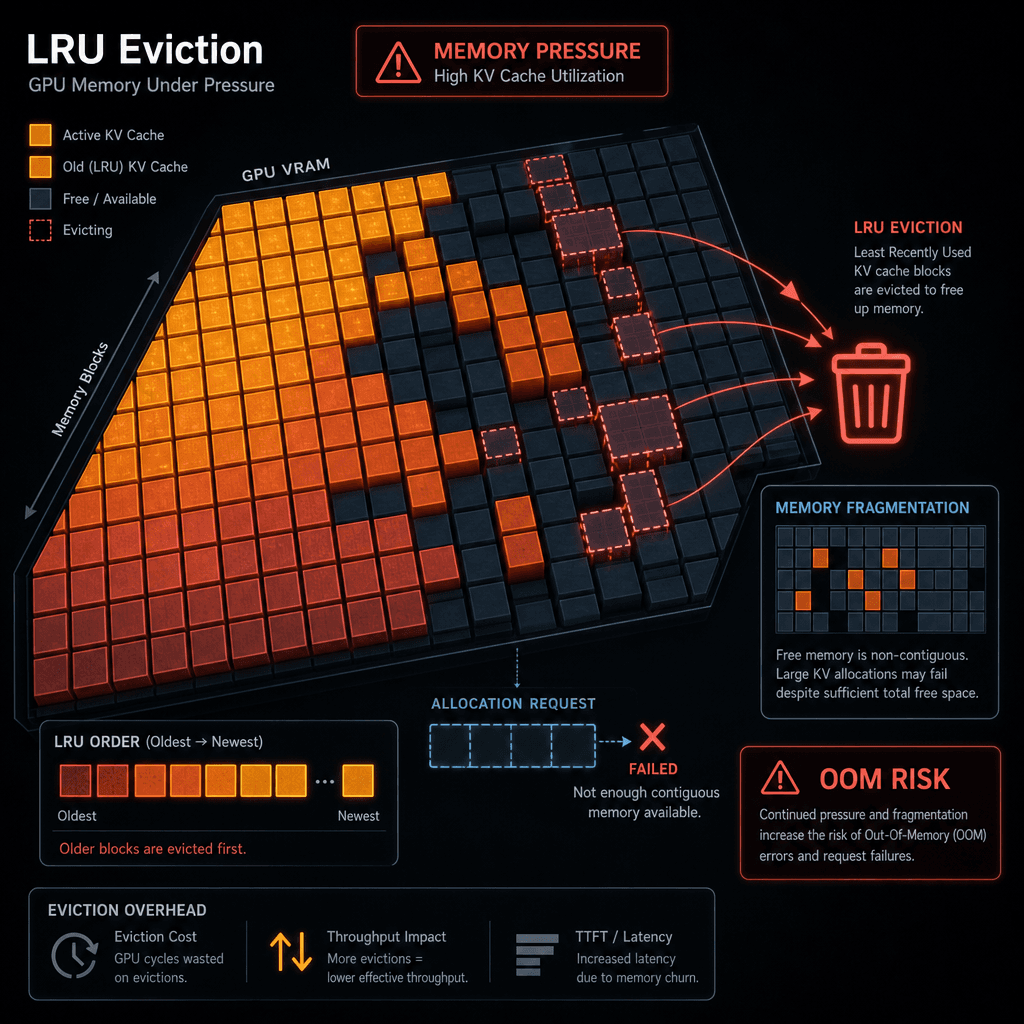
The logical KV cache structure maps directly to physical GPU memory resources. Each token in the prefix occupies a fixed amount of memory per layer and head. If the workload involves many unique prefixes, the KV cache consumes increasing amounts of GPU memory, leading to memory fragmentation or eviction of older entries. vLLM uses a Least Recently Used (LRU) policy to evict cache entries when GPU memory is full. If the cache is frequently evicting entries that are likely to be reused, the system spends memory bandwidth on cache management rather than inference. In extreme cases, this can lead to increased latency due to memory thrashing.
Common Pitfalls
When implementing prefix caching, engineers often fall into specific traps that reduce its efficacy or destabilize the system.
- Overestimating Hit Rates: Assuming high cache hit rates based on semantic similarity. Prefix caching relies on exact token-level matching. Semantically similar but token-differently prompts (e.g., due to different tokenization of numbers or slight phrasing changes) will result in cache misses.
- Ignoring Memory Overhead: Failing to account for the GPU memory reserved for the cache. In high-concurrency scenarios with diverse prompts, the cache can grow large enough to starve the model weights or activation buffers, leading to OOM errors.
- Not Monitoring Metrics: Deploying prefix caching without monitoring
vllm:gpu_prefix_cache_hit_rate. If the hit rate is consistently low, the overhead of cache management becomes a net negative.
Operational Considerations
To leverage prefix caching effectively, engineers should monitor cache hit rates and adjust configurations accordingly.
Enabling Prefix Caching
Prefix caching is not enabled by default in vLLM. To enable it, use the --enable-prefix-caching flag. To explicitly disable it, use the --no-enable-prefix-caching flag. Ensure you set the correct flag when launching your server.
Monitoring Cache Hit Rates
vLLM provides metrics to monitor cache performance. Use the vllm:gpu_prefix_cache_hit_rate metric to track the percentage of requests that benefit from caching. A low hit rate indicates that the workload may not benefit from prefix caching, and you might consider disabling it to reduce memory overhead.
Memory Management
Be mindful of the --gpu-memory-utilization parameter. Allocating too much memory for the KV cache can leave insufficient memory for model weights and execution buffers, leading to OOM (Out of Memory) errors. Balance the cache size with the available GPU memory based on your typical prompt lengths and concurrency levels.
Practical Takeaways
- Enable for Shared Prompts: Activate prefix caching when you have long, static system prompts or templates shared across many requests.
- Monitor Hit Rates: Regularly check
vllm:gpu_prefix_cache_hit_rate. If it is below 10-20%, consider disabling caching to save GPU memory. - Watch Memory Usage: Ensure
--gpu-memory-utilizationleaves enough headroom for dynamic KV cache growth to prevent OOM crashes. - Beware of Short/Unique Inputs: Prefix caching provides minimal benefit for very short prompts or highly variable user inputs.
Conclusion
Prefix caching in vLLM is an effective optimization for reducing TTFT, but its effectiveness is workload-dependent. It excels in scenarios with high prompt similarity, such as shared system prompts or batched requests with common templates. However, it offers little benefit for highly unique inputs, short prompts, or when memory pressure leads to frequent cache evictions.
Engineers should evaluate their specific use case, monitor cache hit rates, and adjust configurations to maximize the benefits of prefix caching. By understanding the mechanism and limitations, you can make informed decisions to optimize your LLM inference pipeline.
FAQ
Q: Is prefix caching enabled by default in vLLM?
A: No, prefix caching is not enabled by default in vLLM. You need to explicitly enable it using the --enable-prefix-caching flag.
Q: How does prefix caching affect GPU memory usage? A: Prefix caching consumes additional GPU memory to store the KV states of cached prefixes. If the cache grows too large, it can lead to memory fragmentation or eviction of older entries, potentially impacting overall system stability.
Q: Can prefix caching improve Tokens Per Second (TPS)? A: Primarily, prefix caching improves Time To First Token (TTFT) by skipping the prefill phase for common prefixes. It does not directly improve the generation speed (TPS) of individual tokens, though it can free up compute resources for decoding if memory pressure is reduced.
Q: What happens if two prompts are semantically similar but tokenized differently? A: Prefix caching relies on exact token matching. If the tokenization differs, even slightly, the cache will not recognize the prefix as a hit, resulting in a cache miss and no performance benefit.
Q: How do I disable prefix caching if it causes issues?
A: You can disable prefix caching by omitting the --enable-prefix-caching flag from your vLLM launch command, or by using the --no-enable-prefix-caching flag if it was enabled elsewhere.
Related posts
Caching Strategies for RAG Pipelines
Explore effective caching strategies for RAG pipelines, including embedding and retrieval caches, to improve hit rates and reduce latency, while managing invalidation effectively.
Ollama vs vLLM vs llama.cpp: Picking the Right Runtime
A technical comparison of Ollama, vLLM, and llama.cpp inference runtimes for developers and ML engineers.
Roofline Analysis for LLM Serving
A practical guide to applying the roofline model for analyzing GPU utilization and MFU in large language model serving environments.
